The stakeholders of the Advanced Technologies for Sustainable Cities (SUIT) Platform are institutions and organizations that possess significant research infrastructures in the relevant fields, have carried out numerous studies on these topics, including various projects funded by national and international organizations, and have produced important outputs.
Inter-Project Relations
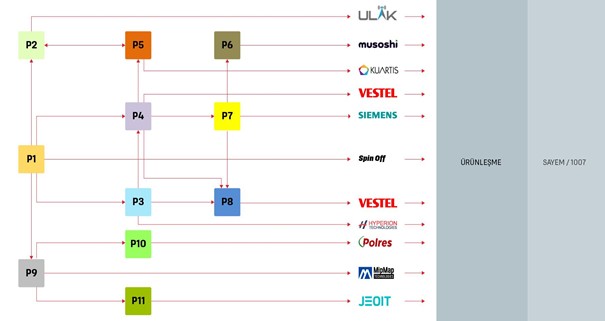
The projects within the Research Program are interconnected in a chain-like manner at certain points: the Fresh Wi-Fi mode developed in Fresh-IoT (P1) will be adapted to the IEEE 802.11p standard and transferred to P2 (U-COM). After being implemented on DSRC modems within P2, vehicle integration and pilot applications will be carried out in P5 and P6. In addition, the Age-of-Information-aware sampling algorithms and the A3L-FEC protocol developed in P1 are planned to be used within P9 and in the IoT systems targeting P10 and P11.
The P4 project will design new IoT hardware by benefiting from the outputs of P1 and P3. The A3L-FEC product developed in P1 is planned to be integrated into the Telemetry Control Unit within the scope of P4, and this unit is intended to be used in the electric vehicles of P5 and P6. In addition, P4 will develop a self-learning air-conditioning product by making use of the algorithms to be produced in P8. The IR IoT nodes developed in P3 are envisaged to be used in P8 for room occupancy estimation in the self-learning air-conditioning system. The products emerging from these projects are planned to be commercialized and disseminated.
Organization and Strategic Objectives
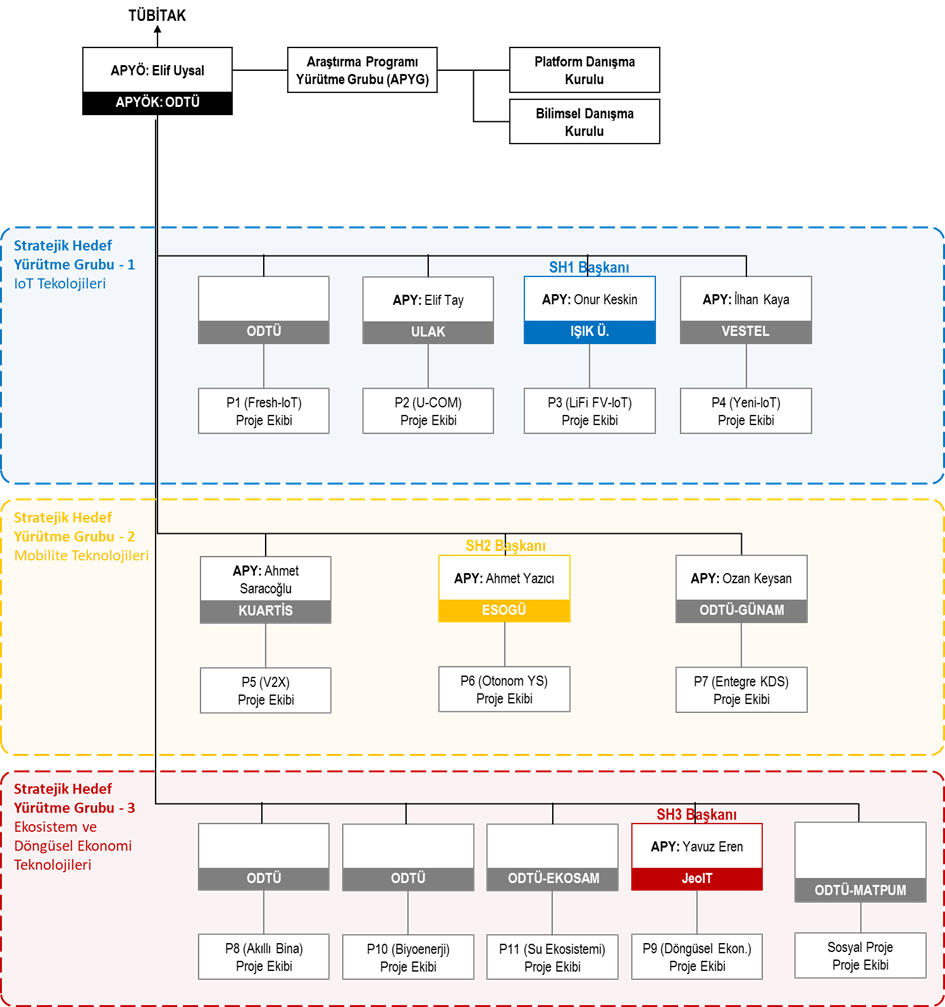
The organizational structure of the SUIT Research Program has been designed to ensure the success of the projects by enabling real-time monitoring of processes, encouraging teamwork and the sharing of experience, establishing and maintaining effective communication channels among all stakeholders, and ensuring self-monitoring in all processes through independent audits and evaluations.
The strategic objectives presented in the SUIT Technology Acquisition Roadmap can be grouped under three main Strategic Objectives:
- IoT Technologies
- Mobility Technologies
- Ecosystem Monitoring and Circular Economy Technologies
In order to ensure that the technical developments, outputs, and commercialization roadmap of the SUIT Research Program are coordinated effectively and dynamically toward these main objectives, a Strategic Objective Execution Group has been designated for each one. The Strategic Objective Execution Groups (SHYG) meet every month to conduct evaluations and make decisions.
Stakeholders
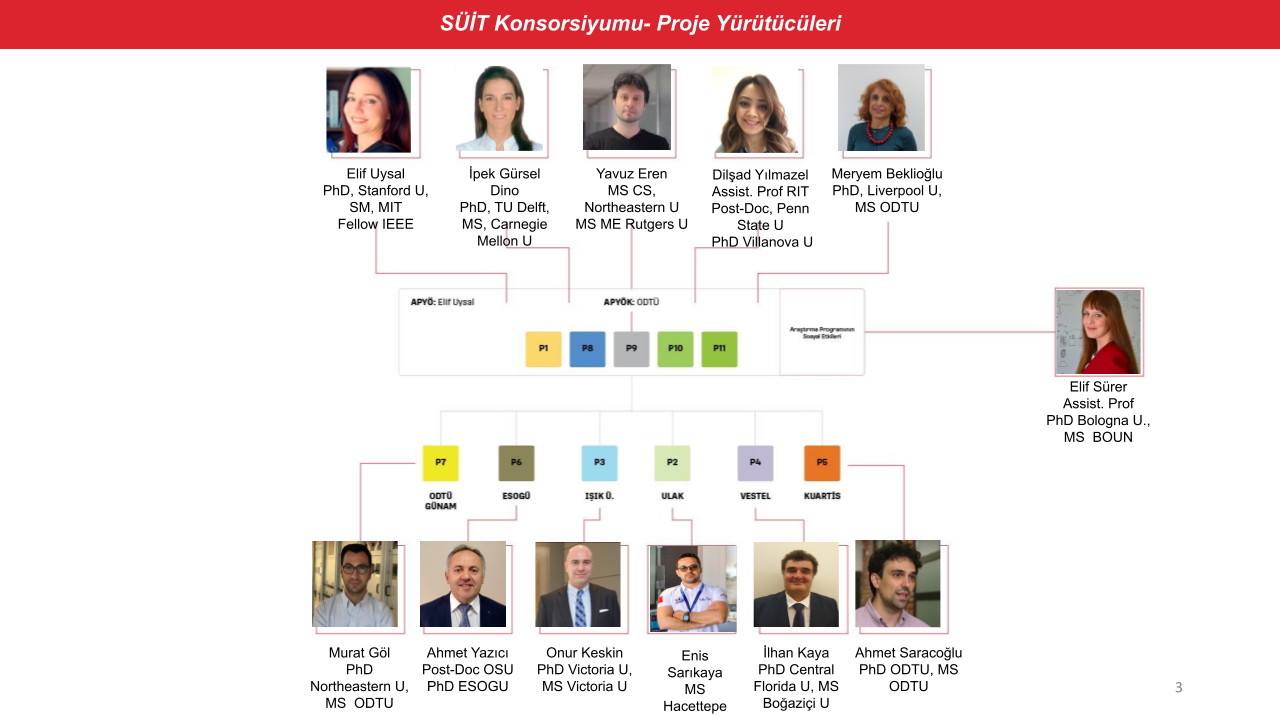
The SUIT Platform APYÖK is carried out within Middle East Technical University (METU), under the Center for Built Environment and Design (YTM – MATPUM). The platform also includes researchers from various departments and research centers, including Electrical and Electronics Engineering (P1, P7, P8), Architecture (P8), Environmental Engineering (P10), Computer Engineering (P8), Civil Engineering (P8), METU EKOSAM (P11), and METU ROMER (P5).
In addition to coordinating SUIT, YTM-MATPUM is responsible for conducting the Social Impacts of the Research Program project. YTM-MATPUM is a leading and action-oriented research center focused on sustainable urban and regional development, advanced urban and building/construction technologies, as well as design and planning. Powered by five innovative research laboratories, YTM & MATPUM has an outstanding research network composed of dedicated professionals, senior consultants, and academics from various departments.
In addition to the APYÖK, 7 different APYK institutions also take part in SUIT:
- METU GÜNAM conducts research in the fields of solar cells, panel technologies, and power electronics, and plays a leading role nationally in these areas.
- IŞIK UNIVERSITY OPAM is one of the few centers in the world capable of designing and producing adaptive optical systems, and the only competent center in this field in Türkiye.
- ESKİŞEHİR OSMANGAZİ UNIVERSITY (ESOGÜ) Smart Systems Application and Research Center (ASİST) carries out research and development activities in the industrial applications of smart systems through national and international collaborations in line with sectoral needs.
- ULAK COMMUNICATIONS Inc. carries out R&D and engineering activities for mobile and broadband communication systems used by commercial network operators, and also undertakes the production, testing, assembly, integration, sales and marketing, import and export of these systems and their spare parts, as well as training, maintenance, and support services.
- With a total of 24 companies under its structure, 15 of which are located abroad, VESTEL is the export leader of Türkiye’s electronics sector, with exports to 158 countries. The company has an R&D group of more than 1,500 people and is a leading actor in its sector through its innovations in the use of next-generation technologies in consumer applications and its patents.
- Located in METU Technopolis, KUARTİS is a company specialized in machine learning and autonomous driving, providing intelligent and energy-efficient infrastructure solutions for large-scale military and civilian projects.
- GeoIT, an SME located in Bilkent Cyberpark, has been operating in the field of smart cities since 2008.